Rail
A nationally integrated, autonomous-capable rail network on a common modular carriage platform — articulated, variable-gauge, energy-resilient rolling stock built to a single sovereign standard.
Sovereign national infrastructure
A sovereign Australian national infrastructure programme. One programme unifying rail, manufacturing, energy, telecommunications and the places they serve — built, owned and standardised in Australia.
ARIA is a generational infrastructure undertaking that began as a Hunter Region transit proposal and has scaled to a national, sovereign programme of 235 corridors covering 47,836 km across every Australian jurisdiction.
Rather than treating rail, manufacturing, energy and telecommunications as separate projects, ARIA integrates them into a single coordinated delivery — a common technology platform, a single set of standards, and an Australian-controlled financing and industrial base.
The result is a network designed as one system: 235 routes, 374 network access points, the eleven sovereign factories that build its rolling stock and the precincts it unlocks, sequenced together across eight jurisdictions under a single capital envelope of A$487.78 billion (P50).
A nationally integrated, autonomous-capable rail network on a common modular carriage platform — articulated, variable-gauge, energy-resilient rolling stock built to a single sovereign standard.
Eleven sovereign manufacturing nodes producing rolling stock, modular rail systems, buses, civil construction and resource equipment — onshore industrial capability retained in Australia.
A clean-energy backbone with sovereign retail capability, firming arrangements and a green-hydrogen transition pathway, sequenced to a net-zero programme target.
A dedicated programme telecommunications and data backbone — interoperable signalling, network automation and a national sovereign data strategy.
Precinct-scale development anchored to the network — housing, skills academies and economic uplift built around corridor and node investment.
Current controlled baseline · all earlier baselines superseded
Eight jurisdictions. One standard. A continental network anchored to sovereign manufacturing nodes and corridor precincts.
Per-jurisdiction breakdown · Wave 6.3 · ARIA-RJR-001 Rev 3.1 Annex F · 235 routes / 47,836 km
| Jurisdiction | Routes | Network km | Capital (P50) |
|---|---|---|---|
| NSW New South Wales | 68 | 11,094 | A$100.91B |
| VIC Victoria | 29 | 4,499 | A$34.33B |
| QLD Queensland | 37 | 7,993 | A$80.74B |
| WA Western Australia | 25 | 5,760 | A$112.08B |
| SA South Australia | 24 | 4,102 | A$45.14B |
| NT Northern Territory | 18 | 3,820 | A$40.00B |
| TAS Tasmania | 14 | 1,191 | A$17.05B |
| ACT Australian Capital Terr. | 5 | 246 | A$2.57B |
| TJ Cross-border (TJ) | 15 | 9,131 | A$54.96B |
| National total | 235 | 47,836 | A$487.78B |
Broadmeadow — the founding ARIA node, anchoring precinct, academy and maintenance capability.
Hunter Region — the programme's genesis, scaled from a regional transit proposal to national delivery.
A coordinated network spanning eight jurisdictions plus 15 cross-border corridors on a single sovereign technology platform.
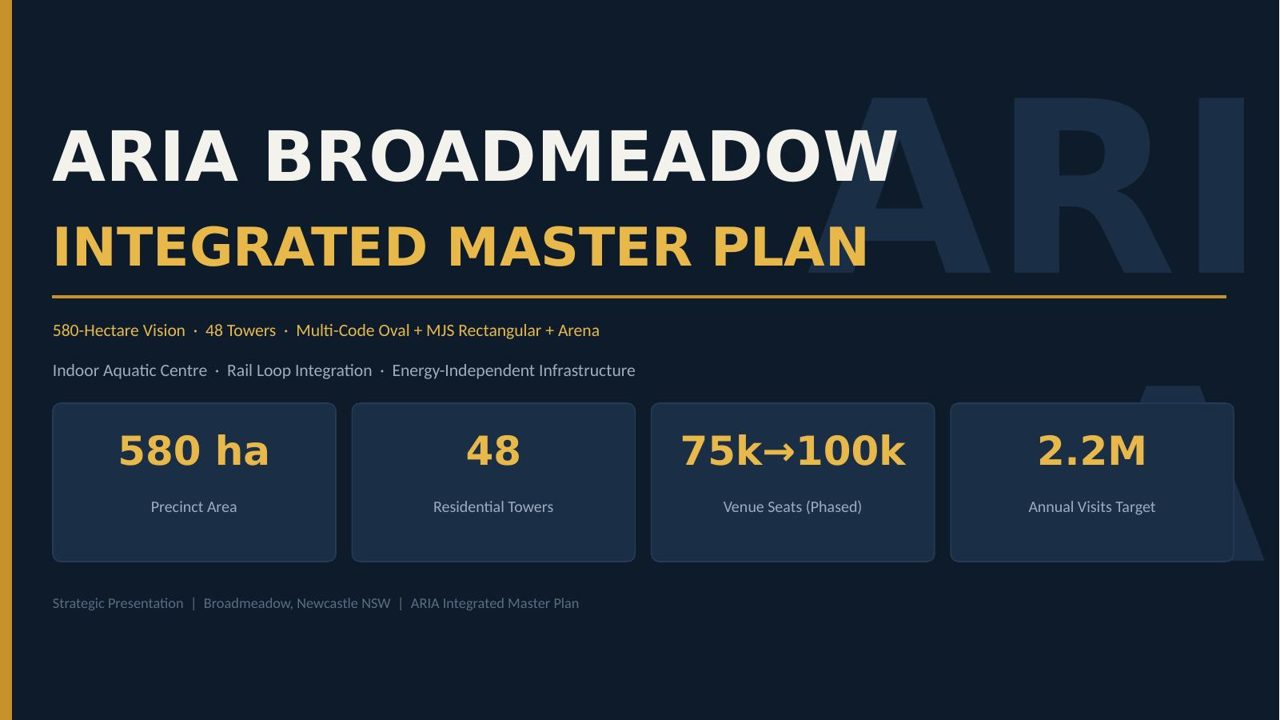
ARIA Node 01 — a 580 hectare integrated master plan delivering 20,200+ apartments across 48 towers, a four-venue sporting precinct, FINA aquatic centre, and an energy-independent rail-loop urban district.
 1 / 20
Broadmeadow goes first. The Integrated Master Plan exceeds the NSW 313 ha Place Strategy by 85%, more than doubles its venue seats, delivers 2.6× its affordable-housing commitment, and reaches 95–98% on-precinct energy self-sufficiency.
The deck walks through the spatial framework, residential uplift, the four-venue sports programme (Multi-Code Oval 45k→60k, MJS Rectangular 30k→40k, ARIA Indoor Arena 15k retractable, FIH Olympic Hockey Hub), Schedule 7 mandatory design guidelines, and a 2026–2040+ delivery staging anchored by the A$1.36B Master Interchange opening in 2028.
Australian-controlled financing, manufacturing and standards
Programme net-zero pathway with staged firming
Steady-state national employment at programme maturity
Modular delivery model compressing build timelines
Programme documents, master plans and supporting materials are held in a restricted library.
Access is limited to authorised users. Sign in to view and download the current document set.
For programme, partnership, jurisdiction or media enquiries, use the form. Submissions are delivered directly to the programme office.
Clifford Fitness Transport Strategy